
How it works
Six stages. One guided workflow.
From the first benchmark to ongoing optimization — EnergyIntel guides every step of the energy management lifecycle.
The problem
Energy management today is fragmented, manual, and slow.
Operators juggle spreadsheets for benchmarking, PDFs for audits, and consultants for every incentive application. Utilities receive inconsistent data that can't be compared across their pipeline. Both sides lose time, money, and opportunity.
Spreadsheets everywhere
Benchmarking lives in dozens of disconnected Excel files. Every update is manual. Every audit is a fire drill.
Consultants for every step
Each assessment, ECM analysis, and incentive application means another procurement cycle. Costs add up. Timelines slip.
Reporting that doesn't scale
Annual reports take weeks to assemble. By the time leadership sees the numbers, the opportunities to act have passed.
The approach
Energy management is a workflow, not a single task.
Most tools cover one piece — a benchmark calculator here, a reporting dashboard there, a separate consultant for incentives. EnergyIntel connects all the pieces so you move from data to decision to outcome without jumping platforms.
Stage 1 of 6
Benchmark — establish where you stand.
Choose the depth that matches your data. EnergyIntel supports multiple benchmarking methodologies — from simple energy use intensity (EUI) for facility-level overviews, to physics-based system benchmarks that quantify exactly how much energy is essential versus wasted.
Upload utility bills, sub-metered data, or detailed operational logs. The platform handles ingestion, normalization, and validation, then calculates the benchmark using the methodology that fits your data.
- Multiple benchmarking methods, one workflow
- Automated data validation and cleanup
- Baseline + reporting period tracking built in
Stage 2 of 6
Identify — find conservation opportunities.
With the benchmark in place, EnergyIntel highlights where the largest energy gaps exist. Equipment profiling — guided by the EI Coach — captures the operational details that turn a benchmark gap into a list of specific, actionable conservation measures.
The platform draws on a structured library of measure types and matches them against your equipment, controls, and operating profile.
- Guided equipment profiling via the EI Coach
- Measure library mapped to facility specifics
- Opportunities ranked by potential and readiness
Stage 3 of 6
Quantify — size the savings.
Each identified measure is quantified using engineering-grade calculations — annual energy savings, demand reduction, payback period, and capital cost estimates. No back-of-the-envelope guesses; every number is defensible.
Quantification methods follow industry conventions used by utility program engineers and consultants, so the numbers translate directly into incentive applications and capital plans.
- Engineering-grade savings calculations
- Cost, payback, and demand outputs per measure
- Methodology transparency — show your work
Stage 4 of 6
Apply — prepare incentive applications.
For measures that qualify under utility incentive programs, EnergyIntel pre-populates the application package — measure description, savings calculations, supporting documentation, baseline evidence — in the format the program administrator expects.
Submission-ready means submission-ready. Utility engineering teams can review without the back-and-forth that normally follows.
- Pre-qualified application packages
- Program-specific format and evidence requirements
- Single-click export to PDF or utility portal
Stage 5 of 6
Report — track and prove performance.
Once measures are implemented, EnergyIntel tracks ongoing performance against the baseline. Monthly, quarterly, or annual reporting — formatted for internal stakeholders, utility program managers, and regulatory submissions — is generated automatically from live operating data.
Reports are not snapshots. They're living, refreshable documents that update as new data arrives.
- Automated reporting against baseline
- Internal, utility, and regulatory formats
- Refresh on demand as data updates
Stage 6 of 6
Optimize — improve continuously.
Operations evolve. Equipment ages, production shifts, weather changes. EnergyIntel re-benchmarks continuously, surfaces new opportunities, and flags performance drift before it becomes a problem.
Continuous optimization closes the loop — what started as a one-time benchmark becomes an ongoing practice.
- Continuous re-benchmarking against current operations
- Drift detection and alerting
- New opportunities surfaced as conditions change
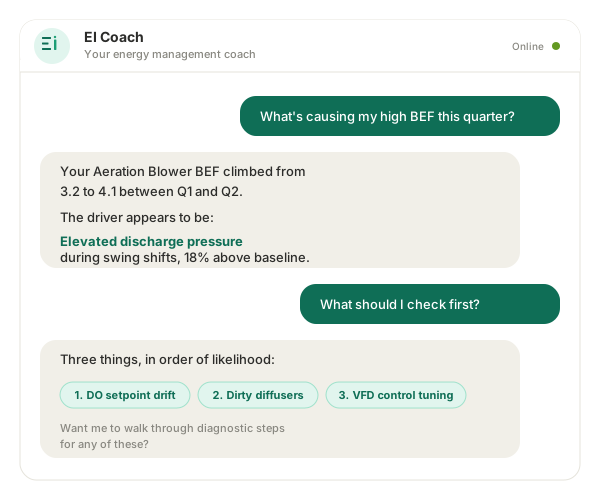
The EI Coach
Engineering knowledge, plain language, 24/7.
The EI Coach is the AI assistant that guides you through every stage. Ask questions in plain language. Get back answers in the language of energy engineering. The coach knows the methodologies, the equipment, the calculations, and the program rules — so you don't have to.
- Walks you through equipment profiling and ECM identification
- Explains the methodology behind every number
- Surfaces the right next step at every stage